




Recently, the groundbreaking research of Dr. Xu Xiang’s team from the Materials Science and Engineering School at Chongqing Jiaotong University has been officially published in the top-tier international journal Nature Communications, under the title “Evaporation-Driven Generic, High-Throughput and Roll-to-Roll Printing of Nanomaterials.” The study proposes a novel generic, high-throughput, evaporation-driven roll-to-roll printing method for nanomaterials, successfully addressing the long-standing industrial challenge of scalable micro and nanomaterial fabrication, thereby injecting strong momentum into technological innovation and industrial applications in related fields.
This five-year scientific breakthrough originated from an unexpected yet highly valuable experimental observation. As a core participant in the school’s “Undergraduate Research Program,” Yuwie Liu, an undergraduate from the Class of 2017, joined Dr. Xiang’s team. During a routine experiment, he accidentally observed that a uniform and dense graphene oxide film spontaneously formed on a substrate floating on the surface of a graphene oxide dispersion. Recognizing the significant potential of this phenomenon, Dr. Xiang, leveraging his profound research experience and acute scientific insight, promptly guided Liu in systematically exploring key parameters such as substrate material properties, environmental temperature control, and dispersion concentration ratios. Through extensive comparative experiments and data validation, they gradually outlined the core framework of the “evaporation-driven nanomaterial printing” technology.
To further elucidate the film-formation mechanism and expand the technical applicability, Dr. Xiang invited his postdoctoral co-supervisor, Professor Zhikang Xu from Zhejiang University, to guide the research, establishing a cross-institutional collaborative network. Subsequently, research talents including Dr. Jiahui Xin and Professor Chao Zhang joined the team, fostering deep integration and collaborative efforts between the two universities. After numerous experimental verifications and mechanistic analyses, the team achieved a key breakthrough: evaporation, as a natural driving force for film formation, exhibits no special selectivity toward the material. This important characteristic indicates that the technology is not only applicable to graphene oxide but also compatible with most micro and nanomaterials such as carbon nanotubes, quantum dots, and metal nanoparticles, demonstrating strong universality and laying a core foundation for its wide application across multiple fields.
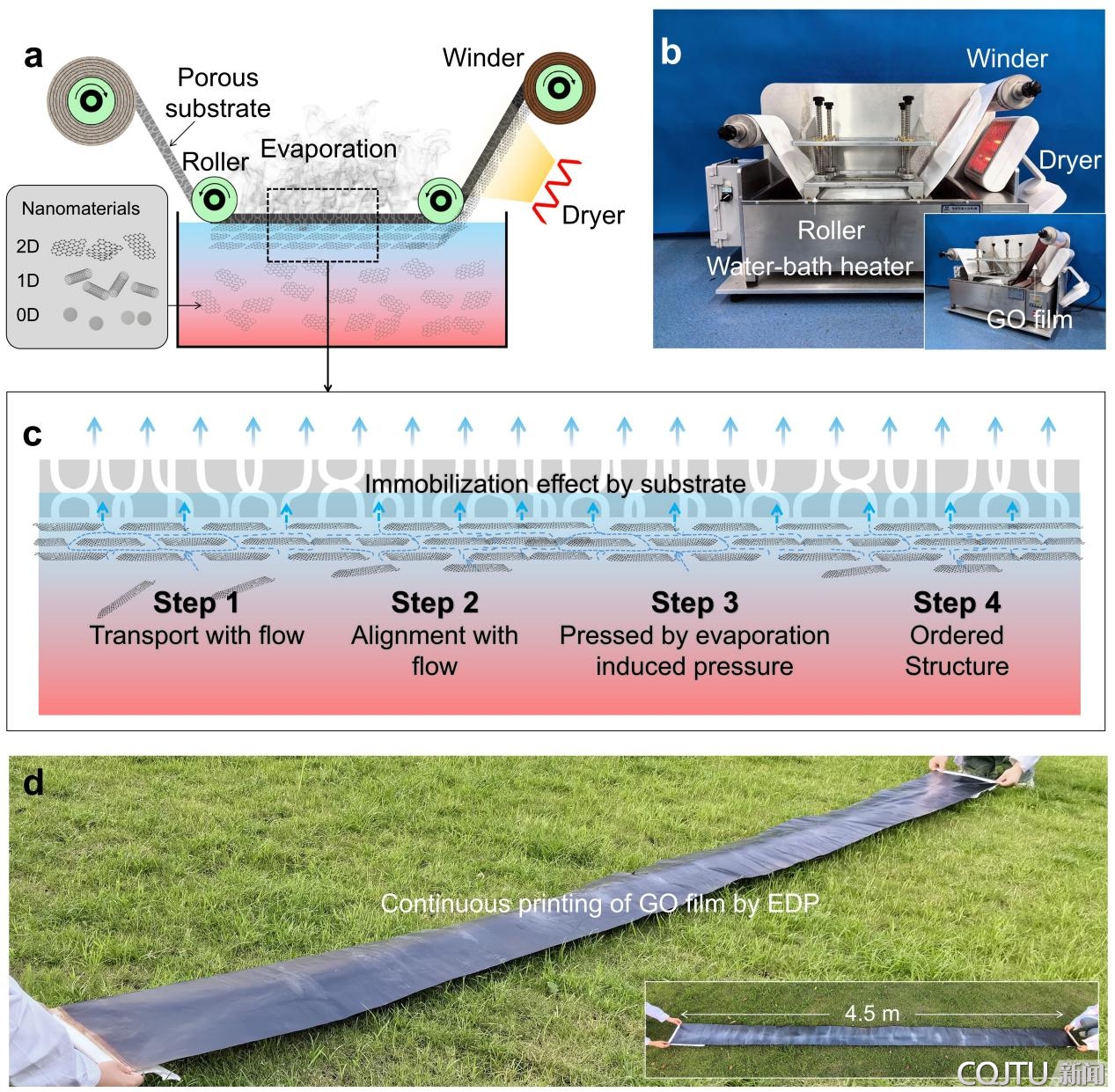
Achieving scalable application is a critical step in transitioning laboratory technology to industry, making “roll-to-roll scalable printing” a central goal for the team. To this end, several graduate students from the Materials Science and Engineering School, including Haiyun Ou and Zhihan Liu, proactively engaged in the research, forming a technical group. Throughout the process, the team encountered several technical bottlenecks, including intermittent operation of continuous production devices, insufficient uniformity, and fragility. Facing these challenges, the students persevered, repeatedly optimizing the mechanical structure of the setup and precisely controlling operational parameters such as temperature and humidity under their supervisors’ guidance. Through hundreds of adjustments and improvements, they overcame each obstacle one by one, ultimately achieving stable and continuous preparation of meter-scale graphene oxide films, clearly demonstrating the immense potential of this technology for large‑scale production. The research paper simultaneously presents schematic diagrams of the evaporation-driven roll-to-roll process, photographs of the actual equipment, dynamic records of the printing process, and images of the resulting meter-scale graphene oxide films, illustrating the feasibility and advancement of the technology.
From an undergraduate’s accidental discovery to the collaboration of a multi-institutional team, the attainment of this high-level research achievement is inseparable from the full dedication and sincere cooperation of every participant. Throughout the research process, the team not only gained valuable scientific experience and innovative ideas from their collaborators at Zhejiang University but also established an efficient research model characterized by cross-institutional collaboration. Undergraduates cultivated scientific thinking and observational skills under mentorship, while graduate students honed their research innovation and technical capabilities by tackling real-world engineering challenges. Researchers from different academic stages and disciplines fulfilled their respective roles, complementing each other’s strengths and becoming a vital force driving the continuous breakthroughs of the research.
Over the years, Materials Science and Engineering School has consistently adhered to the developmental philosophy of “cultivating talents through research and collaborative innovation,” meticulously building high-quality research practice platforms and establishing a distinctive talent cultivation system characterized by “tiered training and collaborative participation.” For undergraduates, the focus lies on guiding them to develop scientific inquiry spirit and acute observational abilities through hands-on experimentation. For graduate students, emphasis is placed on enhancing innovative thinking and engineering practice literacy by tackling real research challenges. The publication of this research in a top international journal serves as a vivid reflection of the school’s long-term commitment to refining its talent cultivation model and persistently integrating research with teaching. Moving forward, the team will continue to deepen technological research and promote the industrial application of this printing technology in fields such as flexible electronics, new energy, and biomedicine, contributing academic wisdom and strength to the innovative development and core technological breakthroughs in China’s materials science.
It is reported that Dr. Xu Xiang and Dong Fan from Materials Science and Engineering School have published four papers in esteemed journals including Nature Communications and npj Computational Materials.

 waiban@vip.163.com